The workshop slides
The original presentation, including hidden slides.
Download The workshop slides Lead with AI
Executive workshop · 27 October 2026
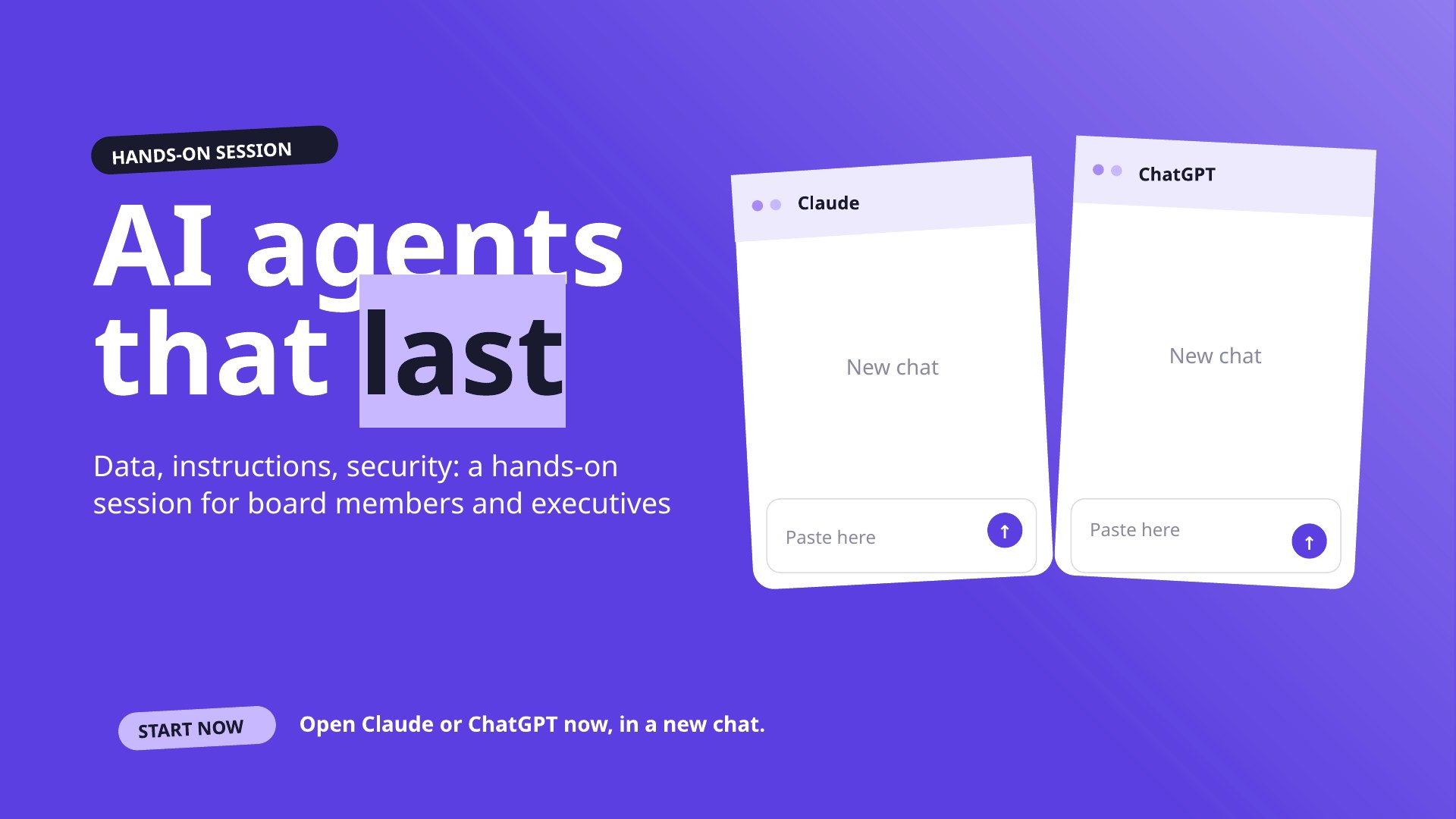
AI agents that last. Data, instructions and security — a hands-on session for board members and executives, with Mustapha Benkalfate.
Explore the workshopBy Mustapha Benkalfate · Revenu IA
The original presentation, including hidden slides.
Download The workshop slidesAll 30 presented slides in one document.
Download The slide handoutBrief, Anchor, Specify, Evaluate. Build and test your agent, one step at a time.
Download BASE© agent creatorThe ready-to-use prompts for your Internal Brain and External Brain.
Download PROBE© promptsThe edited session notes, examples and participant exchanges.
Download The workshop transcriptStart with clean, relevant data.
Show what a good answer looks like.
Test the limits before you give it access.

Three steps, done once, and the method is waiting in every chat you open:
Download a skill file below.
In Claude, open Settings › Capabilities › Skills and upload the file.
Back in a chat, type / in the message box. Claude lists every skill you have installed — pick the one you need and it works your request with that method.
Edited workshop transcript · 27 October 2026. A structured reconstruction, not a word-for-word transcript. It preserves the main exchanges and selected verbatim excerpts. BASE© terminology has been aligned with the supplied handout: Brief, Anchor, Specify, Evaluate.
Mustapha: This was the first session in a proposed series of small-group executive AI workshops. The aim was open discussion rather than a conventional course: participants could interrupt, test ideas and relate them to their own work.
“I am more like I'm in between a trainer and the facilitator today, okay?”
Mustapha introduced Revenu-ia’s focus on AI literacy and fluency, its work across 17 countries, and his research into how business leaders make AI-transformation decisions. He said a recurring problem was that members of the same board or leadership team often did not share the same understanding of AI.
Mustapha invited participants to describe their roles and recent AI use.
CC: As agents receive more authority, how can organizations ensure a human remains the decision-maker? He raised examples involving autonomous vehicles and financial transactions.
Mustapha: The difficult question is not simply whether there is a human in the loop:
“My opinion is, is— Which human?”
He argued that effective oversight requires people who understand an agent’s capabilities, how it was built and the objectives it has been given. In his view, unrealistic or contradictory objectives can produce behavior people did not intend. He also stressed that sometimes the sound decision is not to use AI. These were Mustapha’s assessments, not conclusions established by the group.
CC: contract review. CC said he asks counterparties to run draft agreements through AI before sending them, to assess whether the proposed terms are fair and reasonable. He felt this could surface inequitable terms without making the objection come directly from his side.
Si.: financial-statement review. In a board-training simulation, Si. used Copilot to make a first pass over a 120-page financial statement. Si. specified the audit-committee role and asked it to examine disclosures, numerical inconsistencies and credit-related provisions. It was particularly good at finding inconsistencies—but Si. found further issues on a subsequent read.
Mustapha: Si.’s example illustrated why expertise still matters. The AI did useful initial work; Si.’s own judgment identified what it missed. Mustapha connected this to a broader concern: less-experienced employees may not yet have the knowledge needed to recognize omissions.
Mustapha presented three levels of AI capability:
His practical distinction was: prompt for a one-off task; consider a reusable skill for a recurring personal task; consider an agent when the capability needs to be shared across a group. He warned against treating the number of agents created as evidence of successful transformation. Every additional agent can bring maintenance and security obligations.
Mustapha organized agent creation around data, instructions and security. He said teams often spend time refining instructions when the underlying problem is conflicting, outdated or poorly labeled data. His advice was to begin with a small amount of clean, relevant material and clear ownership, rather than grant access to every available folder.
Si.: Could AI clean the data?
Mustapha: Yes, but it is not always the optimal approach. People still need to recognize when the result requires their own review or intervention. He illustrated simple “file hygiene” with explicit document names that identify a policy and its date or version.
“Showing constantly beats explaining.”
For Mustapha, an example of a good report, presentation or email can convey the desired output more effectively than a long description.
At Pau.’s suggestion, Mustapha used Da. as the example for a design-system demonstration. He took several screenshots from its website and prompted an AI tool to infer reusable visual guidance for AI-generated presentations. He requested a plain-text output, explaining that he wanted a reusable reference while being mindful of token use.
He then described a parallel communication or voice system: provide examples of a person’s past emails or speech so an AI-assisted follow-up better reflects that person’s style. This responded to feedback he had heard from employees that AI-generated messages from a manager felt dry and did not sound like her.
The broader question, he said, was how people value work when a polished result no longer reliably signals the effort behind it. He offered this as a possible reason AI-generated material may be easier to abandon, while noting the challenge of demonstrating business value from AI activity.
Participants opened a shared prompt and tried BASE©, Mustapha’s agent-creation framework: Brief, Anchor, Specify, Evaluate. Rather than immediately writing agent instructions, the method first asks questions about the task, the examples and data it needs, the intended output, and who will own it.
Se. adapted the exercise to a prospective agent that could check business plans against grant or loan eligibility criteria. In reviewing her AI conversation, Mustapha highlighted the value of first asking whether a reusable agent was justified at all. The questions on screen included who would use it, what one session should produce, and who would own the agent and its outputs.
Mustapha: A request such as “I’m sick of this task; automate it” leaves essential context unstated. Unlike a new colleague, a generative-AI tool may proceed without saying the brief is too vague. Taking time to answer basic questions at the start may prevent rework, wasted usage and unsafe autonomous behavior later.
Mustapha asked why a manager and employee should identify two or three tasks where AI would be obviously useful, instead of building many agents.
Se. suggested an early success could encourage further investment. Si. suggested automating individual components before joining them into a larger process. Mustapha agreed Si.’s approach was valuable, then clarified the psychological point he was pursuing: people often experience an initial “wow,” stop using what they built, and later restart the same task. An unmistakably useful application is more likely to be maintained.
Mustapha proposed a recurring organizational use case: compare an internal brain—well-structured company information—with an external brain of selected outside sources. An agent could then help expose differences, gaps and potential improvements, provided the underlying data and sources were managed.
For AI governance, he gave examples:
| Internal information | External information |
|---|---|
| Ambassador reports, tool spending, performance reports, incident logs, roles and owners | Vendor changes, security developments, regulation, competitors and market news |
Mustapha said this comparison could support more grounded governance reporting and board discussions. He also introduced PROBE©, a method that asks the AI to question the user before executing a task—clarifying the real objective, relevant nuances and expected format. For outside information, he emphasized named sources, recency, links and outputs a person can audit.
Mustapha’s risk discussion covered several categories:
These were cases and risk descriptions presented by Mustapha during the workshop; the session did not independently verify their figures or technical details.
He also raised a human risk: overreliance may weaken the very expertise needed to check AI outputs. He referred to research and examples involving cognitive activity and professional deskilling, and called for “intentional cognitive friction”—keeping people actively involved in defining, testing and judging the work.
Mustapha argued for building capability before deploying autonomous agents widely:
The intended outcome was not “one agent for the whole company.” It was a smaller number of relevant, supported agents rather than unrestricted creation without evidence of value.
Si.: The session offered a useful overview, but introduced many unfamiliar terms. He wanted more time to understand concepts such as prompt injection, plugins and prompt forcing.
Pau.: She was still digesting the material and felt that trying the methods would help make them clear.
Mustapha: He acknowledged the density of the first workshop. His reason for covering the risks was that leaders asking for “automation” also need to understand what autonomy, access and maintenance entail.
Pau. then tested the central recommendation:
Pau.: Was Mustapha suggesting that companies should have one shared agent rather than every employee creating their own?
Mustapha: No. His objection was to agent creation as a goal in itself. Train people first; let useful ideas emerge from their work; then filter for applications that bring value and can be maintained.
“The logic of creating more and more and more, and that's— this is the way you measure quality of your AI transformation is probably the opposite of what should be done.”
Se. connected the discussion to universities, students and SMEs, where she saw a need for basic training, security understanding and workable frameworks. To., drawing on a financial-industry background, emphasized that interest in AI must be matched by compliance, security and the ability to give boards confidence in the approach.
Mustapha said he would share the workshop materials and methods, the transcript, and information on Revenu-ia’s training offerings. He also offered to share the Da. design-system output with Pau. and discussed connecting Pau. with Se. concerning a Davos event planned for June 2027. These were stated follow-ups, not confirmations that they were completed.
Understand the tools. Build your assistants. Make informed decisions.
Explore the programmeWork on your business use cases, with training matched to your team's level.
Find your trainingEquip your AI ambassadors to support their colleagues, from a clear framework to autonomy.
Discover AI Academies